By Trisha Reaston, Principal Consultant | FNQ Team Leader
Why Are More FNQ Employers Seeking Neurodiversity Support?
Across Far North Queensland, Strive is seeing a significant increase in requests from employers seeking guidance on supporting neurodivergent employees in the workplace, particularly employees with Attention Deficit Hyperactivity Disorder (ADHD).
Many organisations genuinely want to create inclusive workplaces but are unsure where to begin. Managers often ask:
- What reasonable adjustments should we provide?
- How do we support an employee who discloses ADHD?
- What strategies help staff stay organised and productive?
- How do we balance employee wellbeing with operational requirements?
The good news is that supporting neurodivergent employees does not require a complete overhaul of workplace practices. Often, small, thoughtful adjustments can make a significant difference to employee wellbeing, engagement, productivity and retention.
Research from the Australian Psychological Society highlights that neurodivergent employees often bring valuable strengths, perspectives and problem-solving capabilities, but may face challenges due to workplace systems that were designed primarily for neurotypical ways of working (APS, 2024).
Understanding the Window of Tolerance
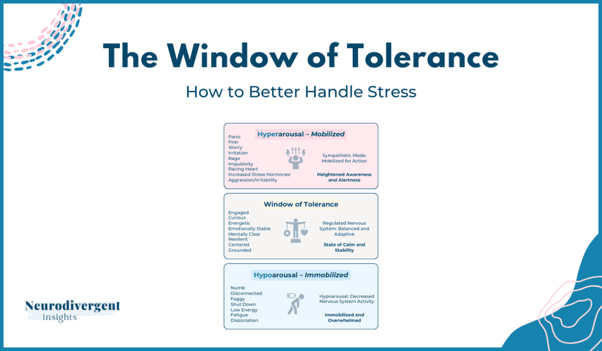
Source: Neurodivergent insights. Available at: https://neurodivergentinsights.com/window-of-tolerance/?srsltid=AfmBOopq25vF5CGEHEGVf0xaSBdWvkQSnXyzaDXLNYEMoxLga0WLfyf6
One concept that can be particularly helpful for employers and supervisors to understand is the Window of Tolerance.
The Window of Tolerance describes the zone in which a person’s nervous system can function effectively. When individuals are within this window, they can think clearly, regulate emotions, process information and engage productively with workplace demands.
Neurotypical Window of Tolerance
For many neurotypical individuals the window is often wider and more stable. Everyday stressors are less likely to push them outside their optimal zone and they may recover relatively quickly after stress. Sensory input (noise, lighting, crowds, interruptions) is less likely to cause overwhelm and they often have greater flexibility during unexpected change or transitions.
Neurodivergent Window of Tolerance
For many neurodivergent individuals (e.g., ADHD, Autism, AuDHD) the window may be narrower or fluctuate more throughout the day. Sensory, cognitive, social, and emotional demands can consume a larger proportion of available regulation capacity and the nervous system may react more intensely to stressors. More energy is often required to maintain focus, social engagement, task switching, emotional regulation, and sensory processing and recovery from overload may take longer.
Neurodivergent employees may move outside their Window of Tolerance more frequently when exposed to:
- High sensory demands
- Multiple competing priorities
- Unclear instructions
- Frequent interruptions
- Unexpected changes
- Excessive cognitive load
When outside their optimal zone, employees may experience either hyperarousal or hypoarousal.
- Hyperarousal is a heightened state of stress or activation. Employees may appear overwhelmed, irritable, anxious, restless, easily distracted or unable to prioritise tasks
- Hypoarousal is a low-energy or disengaged state. Employees may appear fatigued, withdrawn, unmotivated, slow to process information, struggling to initiate tasks or easily “stuck” or mentally foggy.
Understanding these responses can help supervisors view challenges through a support lens rather than assuming issues are related to motivation, attitude or capability.
Evidence-Based Strategies for supporting Neurodivergent staff
1. Reduce Sensory Load
- Lower harsh lighting where possible
- Minimise background noise
- Reduce visual clutter
- Move workstations away from high-traffic areas
2. Provide Noise-Cancelling Headphones
Research consistently identifies sensory management as an important support for many neurodivergent workers. Headphones can reduce distractions and improve concentration.
3. Create Access to Quiet Spaces
Allow employees to utilise:
- Quiet rooms
- Meeting rooms during non-booked periods
- Low-stimulation workspaces for focused tasks
4. Provide Written Follow-Up Instructions
Verbal information alone can be difficult to process during periods of overwhelm. Where possible:
- Follow verbal instructions with written summaries
- Use checklists
- Document priorities and deadlines
5. Break Complex Tasks into Smaller Steps
Reducing cognitive load can help employees regain confidence and clarity when feeling overwhelmed.
6. Clarify Immediate Priorities
Rather than providing numerous tasks simultaneously, identify:
- What needs to happen first
- What can wait
- Which tasks are most critical
7. Schedule Check-Ins
Short, regular check-ins help maintain momentum without creating pressure.
8. Use Visual Organisation Tools
Helpful strategies include:
- Colour blocking in calendars
- Visual task boards
- Time-blocking techniques
- Reminder systems
9. Encourage Movement Breaks
Brief movement breaks can assist with attention regulation and energy management.
10. Consider Body Doubling
Body doubling involves working alongside another person on similar tasks.
This strategy has become increasingly recognised as beneficial for people with ADHD because it can improve:
- Focus
- Accountability
- Task initiation
- Productivity

Across Cairns, Townsville and the broader FNQ region, we are increasingly supporting organisations to build neuro-inclusive workplaces. Most employers are not looking for complex solutions. They are looking for practical, evidence-based strategies that help employees perform at their best while supporting supervisor confidence.
In our experience, the most successful workplaces focus on understanding how employees work best, rather than expecting everyone to work in exactly the same way. Small adjustments, implemented early, can prevent performance concerns, reduce workplace stress and improve retention outcomes for both employees and employers.
Want to Learn More?
If your organisation is looking to better support neurodivergent employees, supervisors or workplace leaders, Strive can provide guidance on:
- Neurodiversity awareness training
- Manager and supervisor coaching
- Workplace assessments
- Reasonable adjustment recommendations
- ADHD workplace support strategies
To learn more, call 1300 361 953 or email info@striveor.com.
Evidence Source
Australian Psychological Society (APS). (2024). Managing a Neurodiverse Workforce. Available at: Australian Psychological Society [psychology.org.au]
The Neurodiverse Safe Work Initiative. (2024). Beyond “Reasonable Adjustments” – Towards Neuro-Inclusive Workplaces in Australia.By Catherine Lee | Workplace Health and Safety. Available at: https://neurodiversesafework.com.au/beyond-reasonable-adjustments-towards-neuro-inclusive-workplaces-in-australia/
Diversity Council Australia (DCA). (2025). Neurodiversity Data at Work. Available at: https://www.dca.org.au/research/neurodiversity-data-at-work
 When work causes harm: Supporting recovery after workplace bullying and harassment